Achievement & Badge System With Flexible Rules
27 billion Xbox achievements unlocked. 116% referral boost from Duolingo badges. 35-50% D1 retention vs. 24% average. Reward ANY behavior with progressive tiers and real-time validation.

Why achievement systems work
From Xbox's 27 billion unlocks to Duolingo's 55% retention, achievement systems prove their effectiveness across platforms.
Xbox achievements unlocked
Microsoft's achievement system proves universal appeal. 27 billion achievements unlocked, 486 billion Gamerscore earned (Microsoft, 2023). Achievements work across all industries.
Microsoft Gaming Division, 2023
Better memory for incomplete tasks
Zeigarnik Effect (University College London, 1927): Incomplete tasks remembered 2x better than completed ones. Progress bars at 73% create stronger motivation than 0% or 100%.
Zeigarnik, 1927; UCL Psychology
D1 retention with achievements
Well-designed achievement systems drive 35-50% Day 1 retention versus 24% industry average (GameAnalytics, 2024). Duolingo achieves 55% next-day retention with achievements.
GameAnalytics Industry Report 2024
Behavior rewarded
Flexible rules engine: Challenge completions, community contributions, purchase milestones, streaks, social sharing—anything your platform tracks. 30+ event types supported.
Nudj Platform Capabilities
Behavioral science
The psychology behind achievements
Self-determination theory
Deci & Ryan, 1985
The science
Intrinsic motivation requires three psychological needs: competence (skill mastery), autonomy (choice of goals), and relatedness (social connection). Achievement systems satisfy all three simultaneously through progression mechanics, player agency in selecting achievement paths, and public recognition. University of Rochester studies (2006-2008) demonstrate that satisfying these needs increases engagement duration by 200-300% versus extrinsic rewards alone.
How Nudj implements it
Progressive tiers (Bronze → Platinum), multiple achievement paths offering player choice, public badge displays on profiles, social leaderboards for comparative status, and achievement-gated rewards requiring mastery demonstrations.
Measurable outcomes
2-3x higher engagement versus points-only systems. Duolingo’s achievement system drives 55% next-day retention by satisfying competence through level progression, autonomy through achievement selection, and relatedness through social sharing.
Explore gamification mechanics →
Zeigarnik effect & endowed progress
Zeigarnik, 1927; Nunes & Drèze, 2006
The science
Incomplete tasks remembered 2x better than completed ones (Zeigarnik, University College London, 1927). Progress bars at 73% completion create stronger motivation than 0% or 100% (Nunes & Drèze, Journal of Consumer Research, 2006). Artificial head starts (giving users 10% progress vs. 0%) increase completion rates by 82% through psychological commitment effect.
How Nudj implements it
Real-time progress bars with precise percentages, near-miss notifications (‘87% - almost there!’), new users start with 10% progress on first achievement, achievement collections prominently display incomplete achievements, tier indicators showing current level and next milestone.
Measurable outcomes
40-60% higher engagement than binary unlocks. Fortnite Battle Pass achieves 95%+ completion rates through visible progress. LinkedIn’s ‘Profile Strength’ meter (showing 60% → 100% progress) increases profile completion by 55%.
Learn retention strategies →
Variable reward schedules
B.F. Skinner, 1930s-1950s
The science
Unpredictable rewards trigger 3-5x stronger dopamine responses than predictable rewards (Skinner’s operant conditioning research, 1930s-1950s). Kahneman & Tversky’s Prospect Theory (1979) demonstrates that rare events are overweighted in decision-making. Hidden achievements create curiosity gaps and status value through scarcity—PlayStation Platinum trophies (0.1% player completion) generate 10x more social sharing than common achievements.
How Nudj implements it
Hidden achievements discovered through exploration (no hints), rare/legendary tiers achievable by top 5% of users, surprise bonuses for unexpected behavior combinations, random trigger events, progressive unlocks revealed only after completion, achievement rarity indicators displaying global completion percentages.
Measurable outcomes
2.5x higher engagement than fixed rewards. PlayStation Platinum trophies (0.1% completion) shared 10x more often. World of Warcraft’s Feat of Strength achievements (hidden, rare) drive 3-4x higher achievement hunt activity versus regular achievements.
See reward mechanics →Social comparison & status signaling
Festinger, 1954; Antin & Churchill, 2011
The science
Social Comparison Theory (Festinger, 1954): Humans evaluate abilities by comparing to similar others. Achievements enable upward comparison (aspirational) and downward comparison (self-affirmation). Carnegie Mellon research (Antin & Churchill, 2011) demonstrates that badge displays increase contributions by 12% due to status signaling. Rare achievements communicate commitment, skill, and time investment to peers.
How Nudj implements it
Public badge displays on user profiles, global rarity indicators (‘top 2.3% of users’), social sharing with automatic posts, comparative stats against friend groups, leaderboards filtered by achievement type, exclusive perks for rare achievements (VIP access, early features), achievement-based user titles.
Measurable outcomes
3-5x higher sharing rates for social achievements. Stack Overflow’s top 1% reputation badges signal expertise—users with gold badges receive 67% more upvotes per answer. Strava’s King/Queen of Mountain segments generate 40% more activity versus non-competitive rides.
Explore community features →
Loss aversion & commitment
Kahneman & Tversky, 1979; Festinger, 1957
The science
Kahneman & Tversky’s Prospect Theory (1979): Losses are psychologically 2.5x more painful than equivalent gains. Streak achievements leverage loss aversion—breaking a 30-day streak feels worse than gaining a 1-day streak feels good. Festinger’s Cognitive Dissonance (1957): Public commitment increases follow-through. Users who announce achievement goals complete them at 65% higher rates versus private goals.
How Nudj implements it
Streak achievements with daily check-ins, visual countdown timers showing streak expiration, recovery mechanics allowing one missed day per month, public achievement pledges shared to social feeds, achievement series requiring consecutive completion (lose progress if skipped), tier demotion warnings before inactivity threshold.
Measurable outcomes
Duolingo’s streak system drives 13% higher DAU (daily active users) versus non-streak users. Wordle’s streak counter creates 2.5x higher daily return rate. Snapchat Streaks engage 60% of users daily through fear of loss.
Build loyalty programs →Goal-gradient hypothesis & completion bias
Hull, 1932; Kivetz et al., 2006
The science
Goal-Gradient Hypothesis (Hull, 1932): Motivation increases as users approach goals. Columbia Business School research (Kivetz et al., 2006) demonstrates that users accelerate effort when nearing completion—coffee loyalty card study showed 2x faster stamp collection when 10/12 versus 2/12. Completion Bias: Humans derive satisfaction from finishing tasks, triggering endorphin release. Achievement completion provides micro-dopamine hits.
How Nudj implements it
Tiered achievements with visible proximity indicators (‘3 more logins for Silver!’), completion percentages displayed prominently, final achievement milestones slightly easier than mid-tier (reducing drop-off), celebration animations intensifying as tiers advance (Bronze = subtle, Platinum = explosive), achievement series with clear endpoints creating psychological closure.
Measurable outcomes
Xbox achievements show 35% higher engagement in final 20% of achievement progress versus first 20%. Coffee loyalty programs with visible progress achieve 82% higher redemption rates (Kivetz et al., 2006). Nudj’s tiered achievements show 40-60% acceleration in user activity when within 15% of next tier.
Track achievement metrics →
Not a badge list — a programmable system
Create achievements for ANY behavior your platform tracks.

Flexible rules engine
Reward ANY behavior: challenge completions, community contributions, purchases, streaks, or custom events. 30+ event types tracked automatically with nested AND/OR logic.
Progressive tiers
Bronze → Silver → Gold → Platinum progression. Each tier creates clear milestones and maintains long-term engagement through visible advancement and goal-gradient motivation.
Real-time unlocks
Achievements unlock in <1 second when conditions are met. Instant notifications, confetti animations, and immediate feedback for maximum reinforcement and dopamine response.
Hidden achievements
Secret achievements discovered through exploration. Creates mystery, curiosity gaps, and organic community discussion about discovery strategies leveraging variable reward schedules.
Achievement analytics
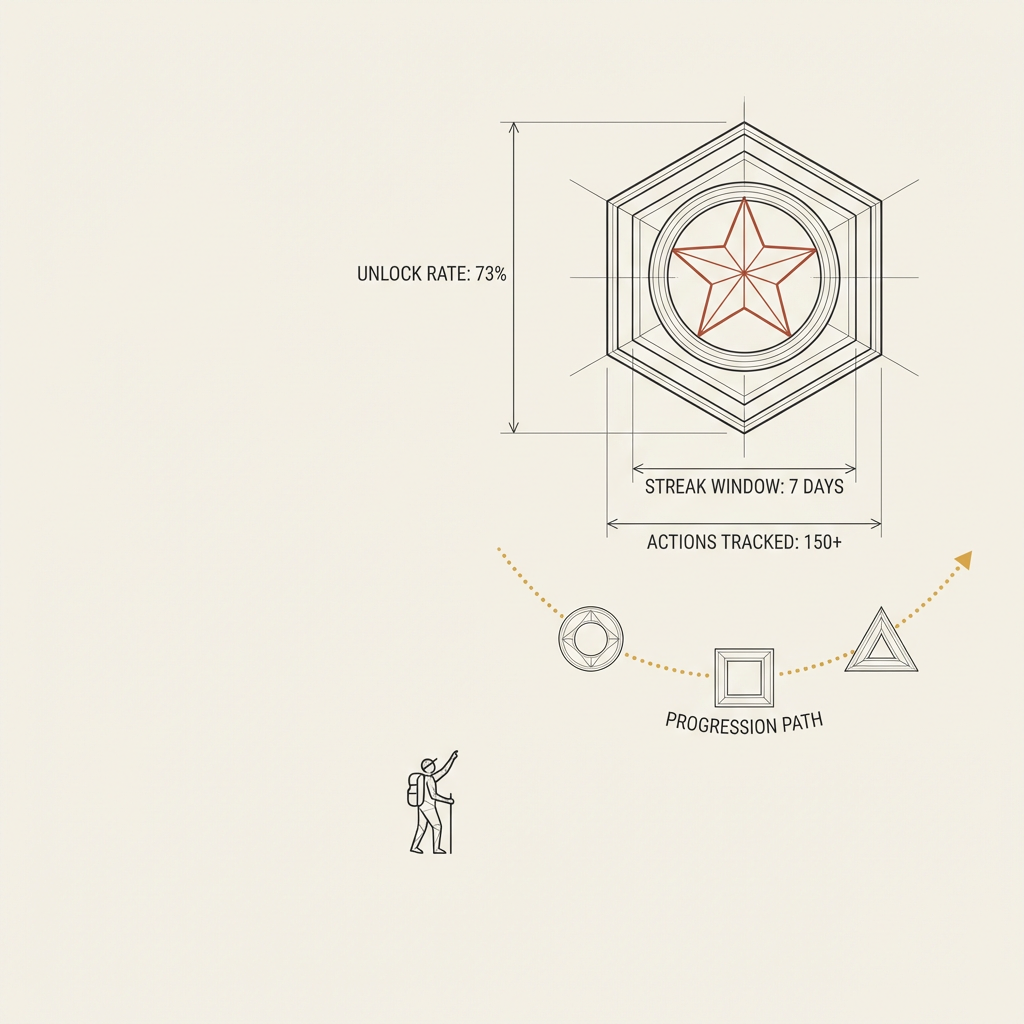
Completion rates, time to unlock, funnel analysis, rarity distribution, and engagement impact. Optimise difficulty based on real user behaviour with 73% completion sweet spot.
Cross-feature combinations
Achievements spanning multiple features: Complete challenge + Share post + Redeem reward = Triple Threat. Guides users to platform breadth and feature discovery.
achievement types — all supported
From simple milestones to complex cross-feature achievements, all configurable with flexible rules.
Milestone achievements
Reward specific numeric thresholds
Skill-based achievements
Reward mastery demonstrations
Time-based achievements
Reward consistency over time
Social achievements
Reward community participation
Hidden achievements
Surprise rewards for exploration
Collection achievements
Reward completing sets
Tiered achievements
Progressive difficulty levels
Cross-feature achievements
Require actions across multiple features
Real-world transformations
Mobile game with 80% day-1 churn
The problem
Mobile game studio (5M downloads) bleeding users: 80% abandon after first session versus 75-80% industry average. No achievement system, no progress recognition, no skill validation. Players complete tutorial and ask ‘Now what?’ No clear advancement path beyond level numbers. Social features underutilized due to lack of status signaling.
How Nudj achievements solved it
Onboarding achievement series (87% completion), progressive difficulty tiers (Bronze at 10 levels, Platinum at 500), hidden achievements for exploration mechanics, social achievements for friend referrals and clan participation, real-time unlocks with confetti animations, achievement-gated character unlocks, streak achievements for daily login bonuses.
Measurable results
- 80% → 52% Day 1 churn (28 point improvement)
- 87% unlock 3+ achievements in first session
- Average session: 8 → 23 minutes (188% increase)
- 30-day retention: 8% → 19% (138% improvement)
- ARPU: $1.20 → $3.80 (217% increase)
- Social sharing: 3% → 24% of users (700% increase)
API-first achievement engine
RESTful API with webhooks, SDKs for JavaScript/Python/PHP, and comprehensive documentation. Configure achievements programmatically or via dashboard.
Create achievement rules
Define achievement conditions with flexible AND/OR logic
POST /api/v1/achievements

{
  "name": "Power User",
  "description": "Complete 10 challenges",
  "tier": "gold",
  "icon_url": "https://cdn.nudj.cx/...",
  "hidden": false,
  "rules": {
    "trigger": "challenge.completed",
    "conditions": {
      "operator": "AND",
      "criteria": [
        {
          "field": "user.challenges_completed",
          "operator": ">=",
          "value": 10
        },
        {
          "field": "user.account_age_days",
          "operator": ">=",
          "value": 7
        }
      ]
    }
  },
  "rewards": {
    "points": 500,
    "badge_id": "power_user_gold"
  }
}
Achievement rules support 30+ event types, custom fields, nested conditions, and time-based logic. Real-time validation ensures rules are conflict-free.
Track user progress
Query achievement status and progress in real-time
GET /api/v1/users/:userId/achievements

Response:
{
  "user_id": "usr_abc123",
  "achievements": [
    {
      "id": "ach_xyz789",
      "name": "Power User",
      "tier": "gold",
      "unlocked": true,
      "unlocked_at": "2024-03-15T14:23:11Z",
      "progress": {
        "current": 10,
        "required": 10,
        "percentage": 100
      }
    },
    {
      "id": "ach_def456",
      "name": "Centurion",
      "tier": "platinum",
      "unlocked": false,
      "progress": {
        "current": 73,
        "required": 100,
        "percentage": 73
      }
    }
  ],
  "total_unlocked": 12,
  "total_available": 47
}
Progress tracking includes real-time percentages, completion predictions, and near-miss notifications for users at 90%+ progress.
Webhook events
Real-time notifications when achievements unlock
POST https://your-app.com/webhooks/nudj

{
  "event": "achievement.unlocked",
  "timestamp": "2024-03-15T14:23:11Z",
  "data": {
    "user_id": "usr_abc123",
    "achievement": {
      "id": "ach_xyz789",
      "name": "Power User",
      "tier": "gold",
      "rarity": 0.023,
      "first_unlock": false
    },
    "trigger": {
      "event": "challenge.completed",
      "challenge_id": "chl_def456"
    },
    "rewards_granted": {
      "points": 500,
      "badge_id": "power_user_gold"
    }
  }
}
Webhook events include achievement unlocks, progress milestones (25%, 50%, 75%), tier upgrades, and streak breaks. Automatic retry with exponential backoff.
Need help getting started? Contact our developer support team or explore our pre-built achievement templates.
Questions & answers
Can't find what you're looking for? Contact our support team
Building achievements in-house typically costs $50K-$100K in engineering time (3-6 months development + ongoing maintenance). You'll need: (1) Rules engine with complex conditional logic, (2) Real-time event processing infrastructure, (3) Progress tracking database architecture, (4) Tier management and progression systems, (5) Analytics dashboard for optimization, (6) Webhook delivery system, (7) API documentation. Nudj provides all of this out-of-the-box with 97% less admin work, allowing your engineers to focus on core product features instead of reinventing gamification infrastructure.
See all gamification features →Explore more
Gamification engine
Achievements unlock XP bonuses, level progression, leaderboard badges, and streak milestones. Progressive tiers mirror level systems for long-term engagement.
Community engagement
Social achievements recognise community contributions. Public badge displays enable status signalling and social comparison (Festinger, 1954).
Reward management
Achievement-gated rewards unlock premium templates at Gold tier, plus purchase milestone achievements and redemption badges driving expansion revenue.
Analytics & insights
Track achievement completion rates, funnel analysis, and engagement impact. Users with 5+ achievements have 3.2x higher retention and 2.8x lower churn.
Customization
White-label achievement badges with custom icons, colors, and tier names. Match your brand aesthetic while leveraging proven psychology.
Integrations
Achievement data flows to Salesforce, HubSpot, Segment, and analytics platforms. Webhook events trigger CRM updates and marketing automation.
Gaming industry
Xbox Achievements (27B+ unlocks), PlayStation Trophies (0.1% Platinum completion), Steam achievements. Gaming pioneered achievement psychology for all industries.
Education
Course completion achievements drive 200% improvement (14% → 42%). Module milestones create psychological checkpoints reducing mid-course dropout by 43%.
Fitness & wellness
Workout streak achievements reduce 90-day churn by 40% (68% → 41%). Personal record badges and body part specialization achievements drive variety and consistency.
Retail & e-commerce
Purchase milestone achievements increase AOV by 34%. VIP tier achievements unlock exclusive early access and personalized product recommendations.
User retention
Achievement systems drive 35-50% D1 retention versus 24% average. Streak achievements and progressive tiers create habit loops maintaining long-term engagement.
User acquisition
Referral achievements drive 700% increase in social sharing (3% → 24%). Friend invite badges create viral loops with built-in progress tracking.
Monetization
Achievement-gated premium features increase conversion by 109% (11% → 23%). Progressive tier unlocks create perceived value and FOMO driving upgrades.
API documentation
RESTful API with 30+ event types, nested AND/OR logic, and real-time webhooks. SDKs for JavaScript, Python, PHP, Ruby, and Go with comprehensive guides.
Next step
Ready to lift retention? See Nudj in action.
Book a focused demo and we will map the highest-impact mechanics for your product and audience.